← Back to all work

Case Study · Traditional course

Frame Your Success

Upgrading Your Virtual Conferencing

A decision-driven course that gets remote-first professionals to actually change how they show up on camera, using only the gear they already own.

My Role

Instructional Designer

Primary Tool

Articulate Storyline 360

Delivery

Self-paced module

Audience

Remote-first professionals

6
modules, five plus a capstone
15+
graded questions
6
question formats
3
design principles carried throughout

The Problem

The camera is on the desk, and the training didn't stop it.

Virtual meetings feel less professional and less connected than in-person ones, and most learners blame the technology. The actual causes are habits the participant controls: camera placement, framing, lighting, background, and audio. Traditional training on this topic uses passive video and recall quizzes, formats that let learners pass an assessment and still show up to the next client call with the camera on the desk.

The design challenge: build a course that produces actual behavior change without asking learners to buy equipment they don't need.

The Starting Point

One measurable goal, mapped in MindMeister.
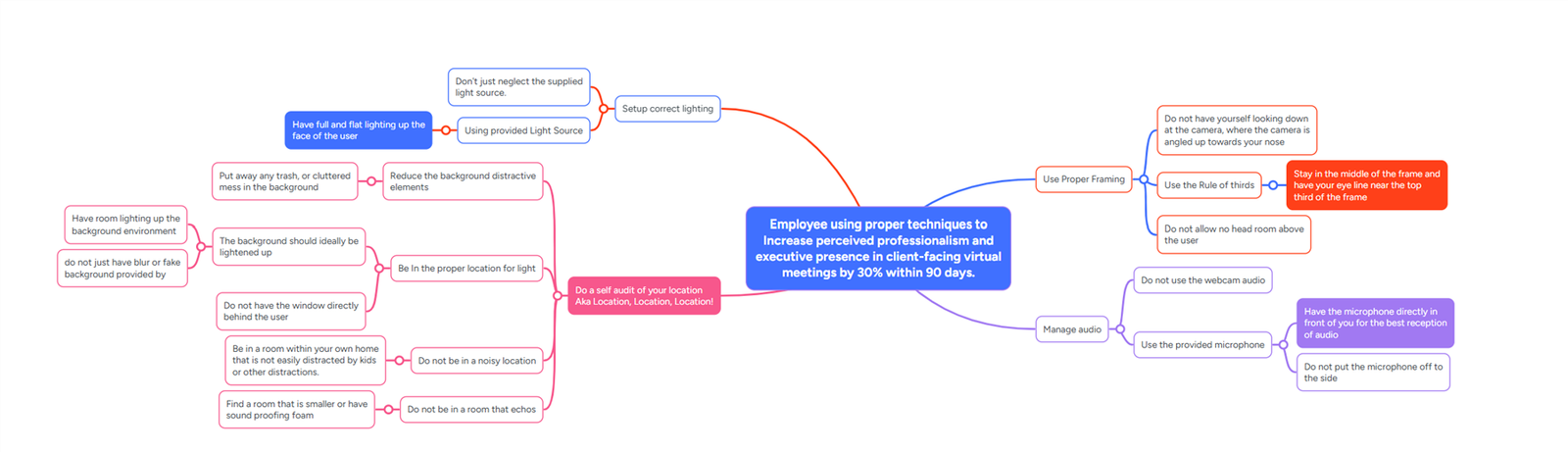
MindMeister mind map breaking the course goal into framing, lighting, audio, and location
The whole course started from a single measurable goal, then branched into the behaviors that actually move it: proper framing, correct lighting, managed audio, and a self-audited location. Every module and question traces back to a branch on this map.

The Approach

Three interlocking principles.

The course is built around three principles, each traceable through every question and interaction.

01

Decision-point scenarios, not recall

Every question stops the story at a moment where the learner has to choose an action. The correct answer is a behavior, not a definition.

02

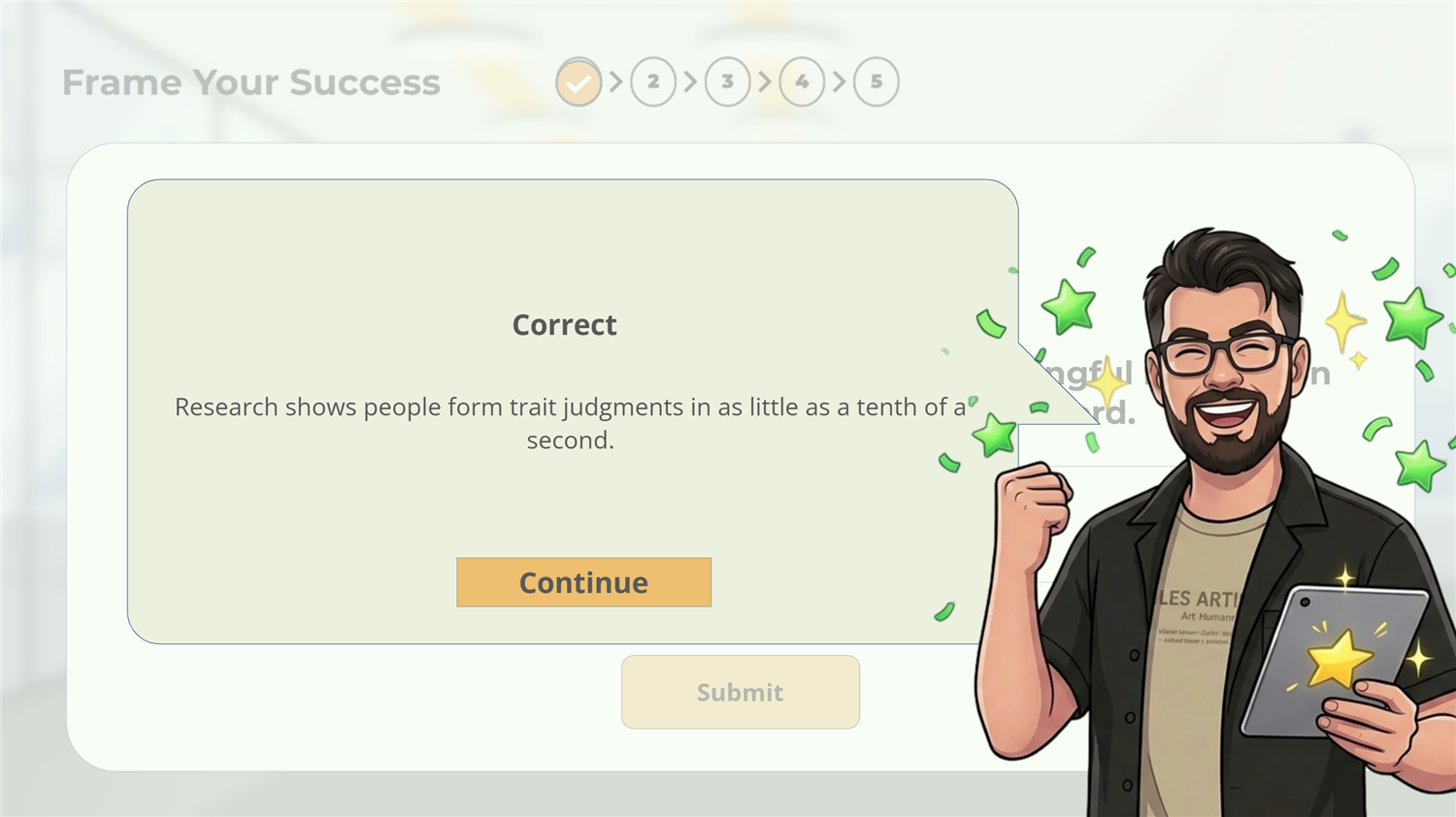
Consequence-style feedback for every option

Each choice, correct or not, continues the story with what would actually happen, then names the takeaway. Wrong answers teach as much as right ones.

03

A zero-equipment philosophy

Every visual and lighting fix uses items already in the learner's home. The single suggested exception (audio, when problems are consistent) is called out explicitly to preserve the rule's credibility.

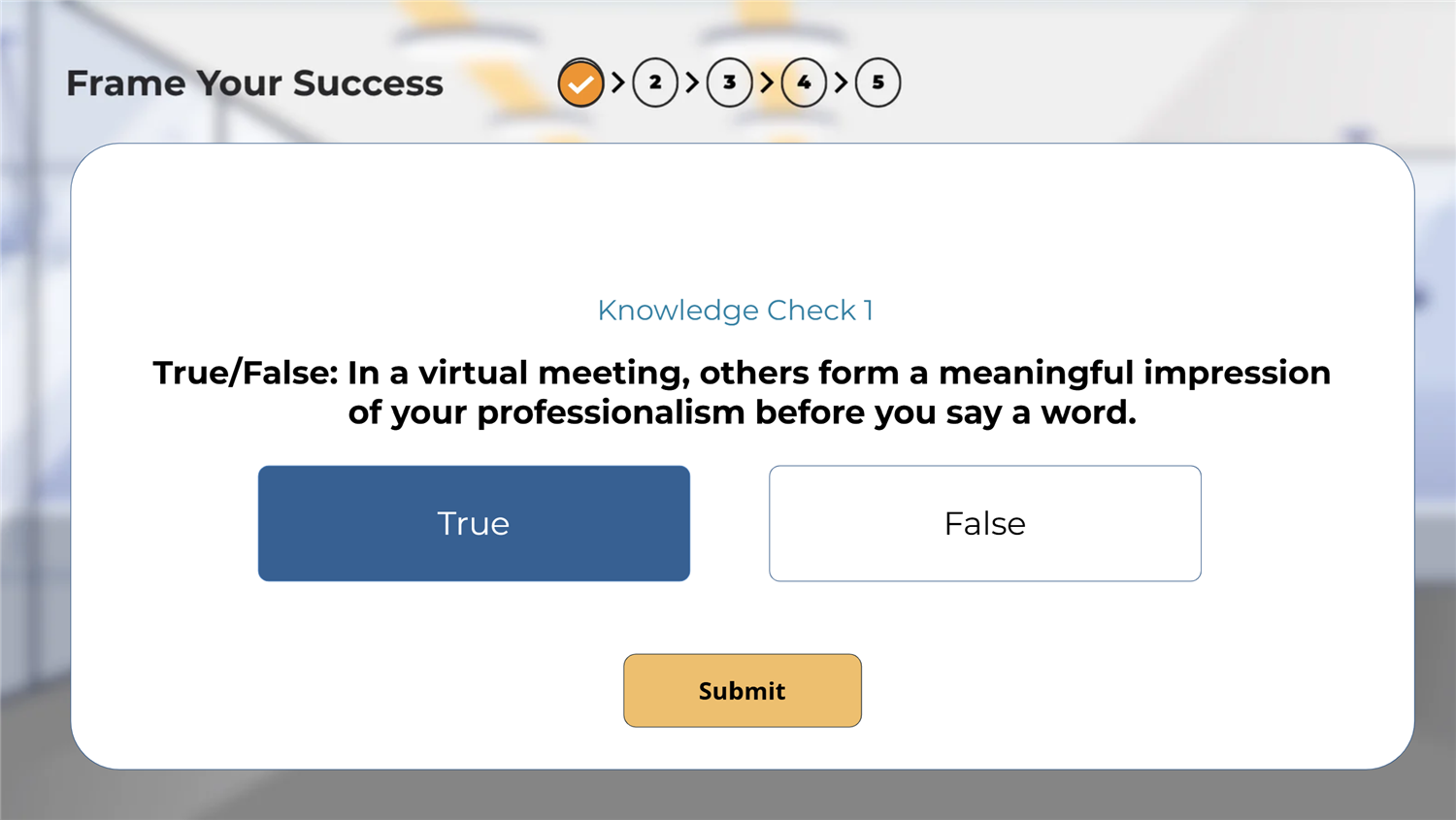
The whole course, scenario branching, hotspot questions, and a custom canvas-based celebration system with Web Audio API sound synthesis, was built in Articulate Storyline 360 using JavaScript.

Course Structure

At a glance.

The course begins with why first impressions matter and ends with a repeatable pre-meeting habit. Formats shift by module because the cognitive work shifts, not because variety is the goal.

Module 01

First Impressions

How professionalism is perceived before you say a word.

Multiple Choice
Module 02

Perspective Equivalence

Eye-level camera and the Goldilocks framing position.

Hotspot
Module 03

Optimizing Lighting

Face the light. Light the room. Skip the equipment.

Drag-and-DropHotspotTrue/False
Module 04

Audio and Background

Test your audio. Curate your background like a gallery.

True/FalseHotspot
Module 05

The 60-Second Self-Audit

One sweep before every meeting. Muscle memory in a minute.

Multi-SelectMultiple Choice
Capstone

In-Meeting Priorities

Once you're inside the meeting, priorities flip.

Multiple ChoiceSorting

From Recall to Decision-Making

The rewrite that drove the whole course.

The same underlying idea, that virtual professionalism is judged before you speak, rewritten from a passive recall check into an active decision-point scenario. This transformation drove the entire question rewrite across the course.

Before · Recall quiz

"Why is perceived professionalism important?"

Four options, one obviously right, the rest transparently wrong.

The learner can pass without engaging with the concept at all.

After · Decision-point scenario

Morgan is joining a meeting with a new department in two minutes: untested mic, cluttered background, old display name. What should Morgan do before joining?

Every option is defensible on the surface. Feedback continues the story with the specific consequence of each choice, then names the lesson. Every choice teaches.

The Illustrated Asset Library

Custom visuals, consistent characters.

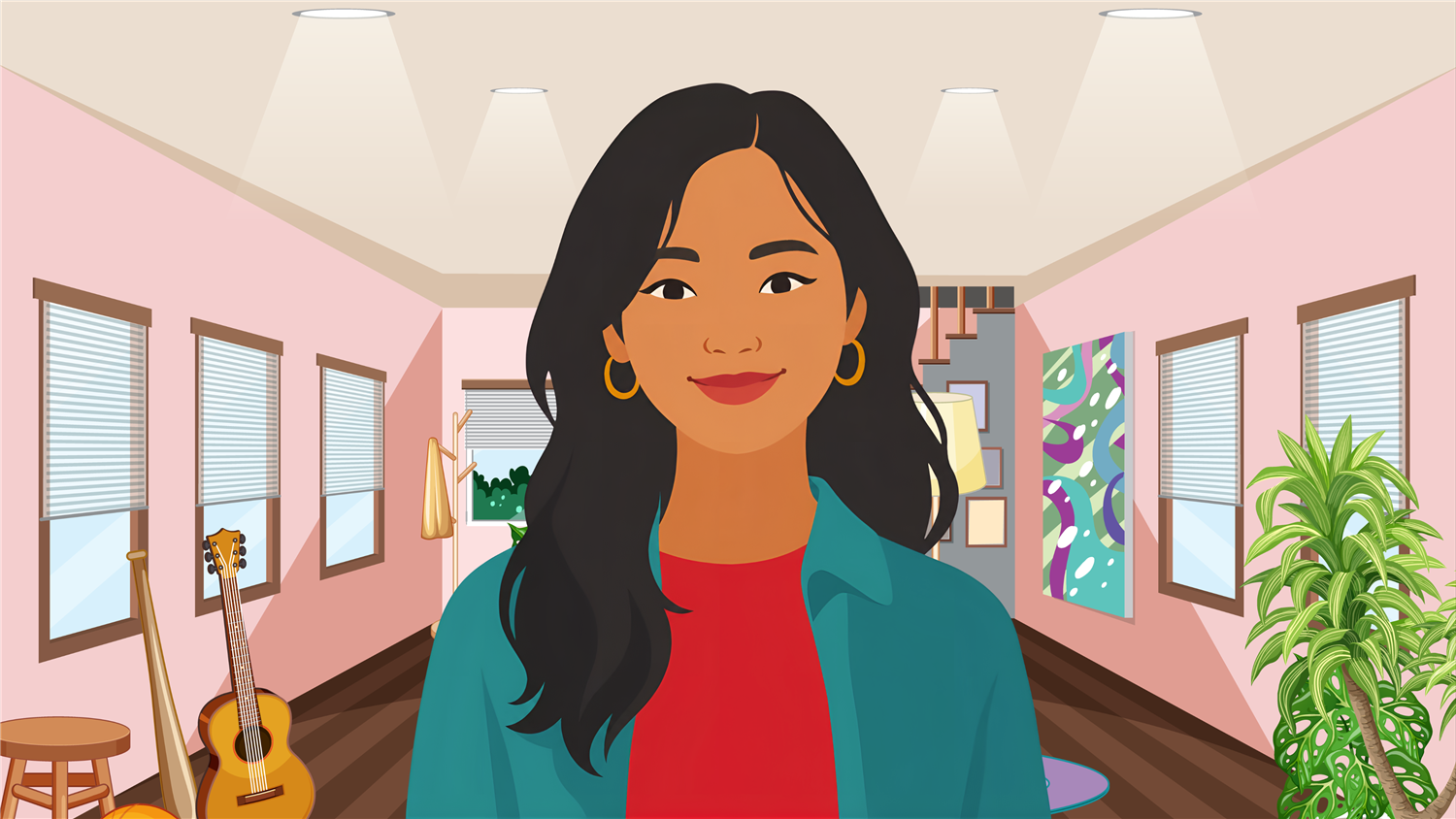
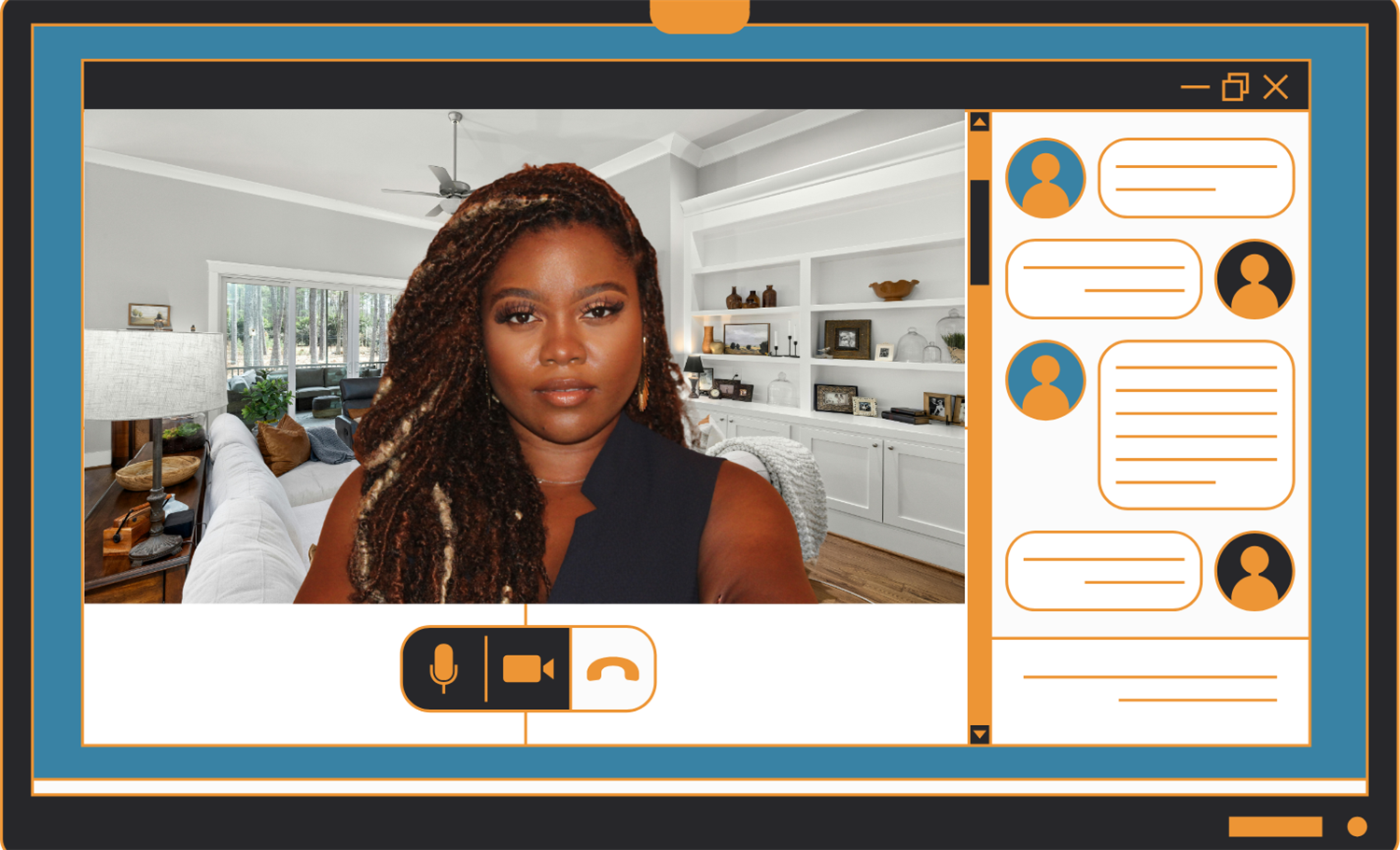
Hotspot and "what's missing" questions run on a library of custom illustrations, with the same characters carried across modules so the story stays coherent.

Inside the Built Course

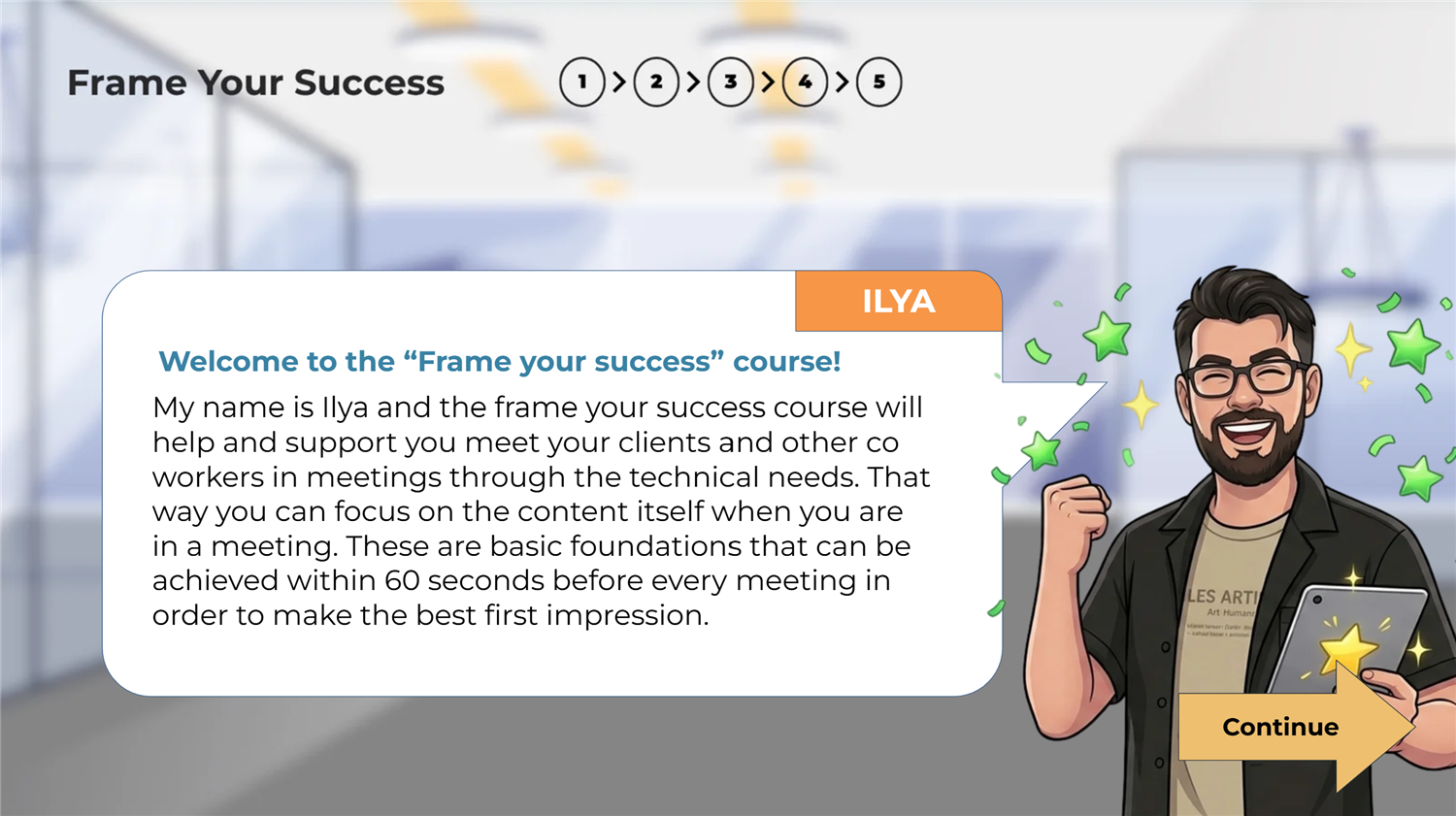
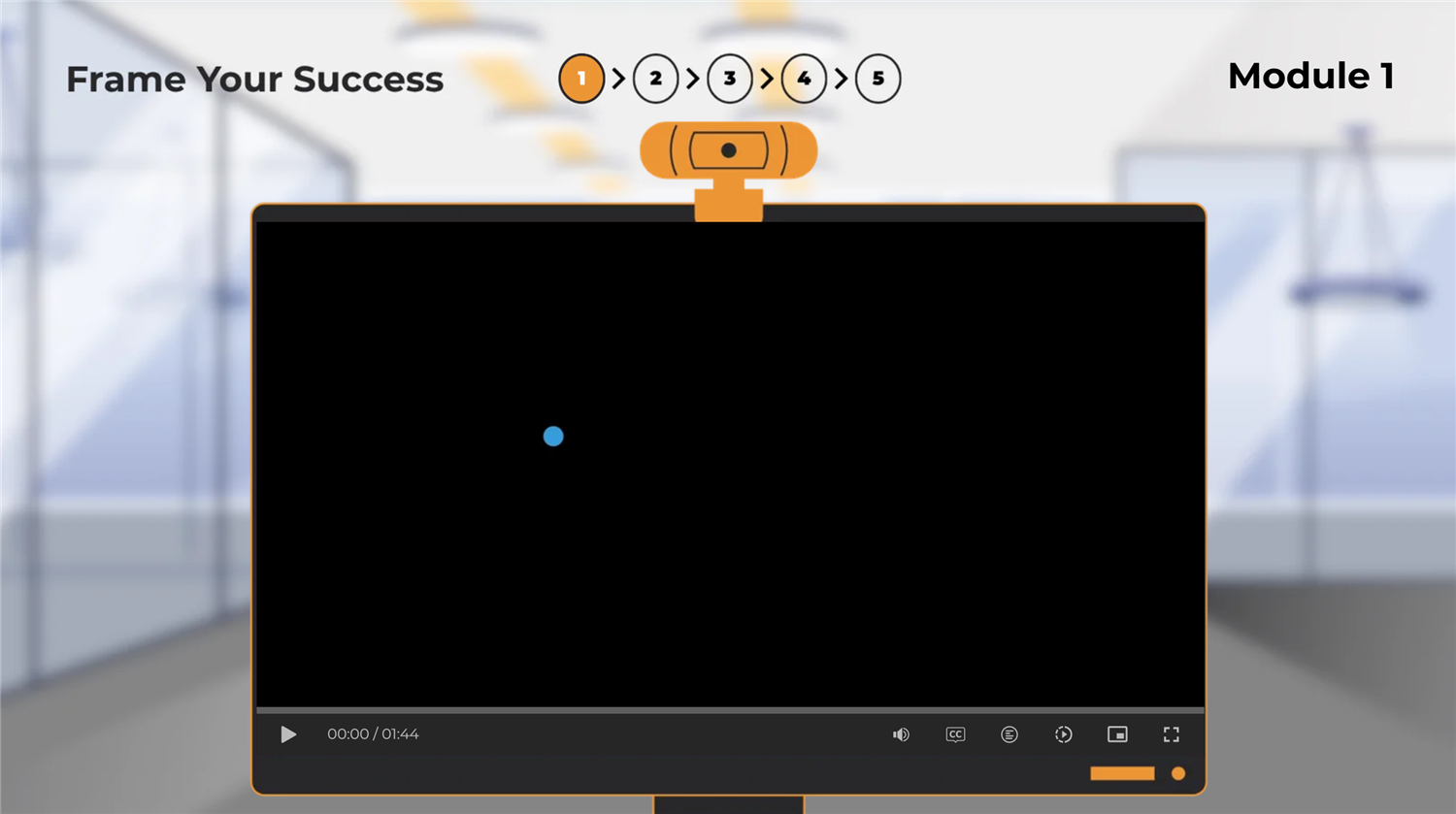
Custom Storyline interactions, start to finish.

The Outcome

What shipped.