Case Study · AI-platform course
Turning a memorization checklist into a decision you have to make: an immersive, branching coaching simulation for new nurses.
The Problem
Every nurse learns the five rights of medication: right patient, drug, dose, route, and time. They're easy to recite and easy to skip under pressure. A slide-and-quiz can prove a learner has read them; it can't prove they'll act on them when a patient can't swallow a pill.
The goal was a training that builds the habit, not just the recall: put the learner on the floor, hand them the Medication Administration Record (MAR), and make them make the calls, with real consequences for the wrong ones.
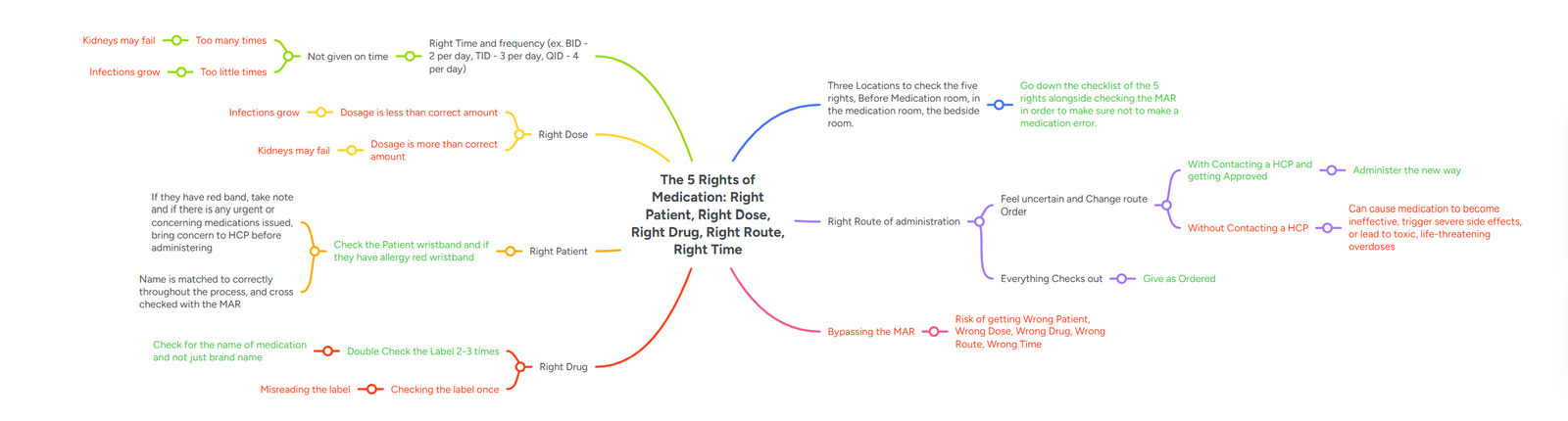
The Starting Point
The Approach
The work split cleanly and stayed in constant dialogue: the SME owned the clinical truth, I owned the experience, and AI collapsed the distance between an idea and something we could both react to on screen.
The RN defined the correct action for each right, the realistic wrong turns, and the specific harm each mistake causes. Every consequence in the sim traces back to the map above.
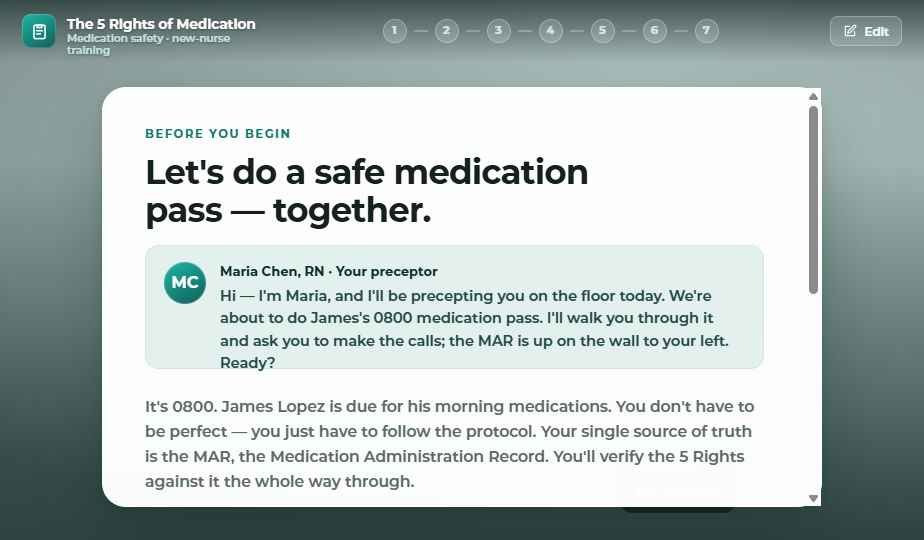
I shaped the fiction of a preceptor walking you through a shift, the decision structure, the feedback voice, and the visual system.
Each concept became a working prototype in minutes, so we could react to a real screen and reshape it the same session. Weeks of build cycles became a conversation.
The Evolution
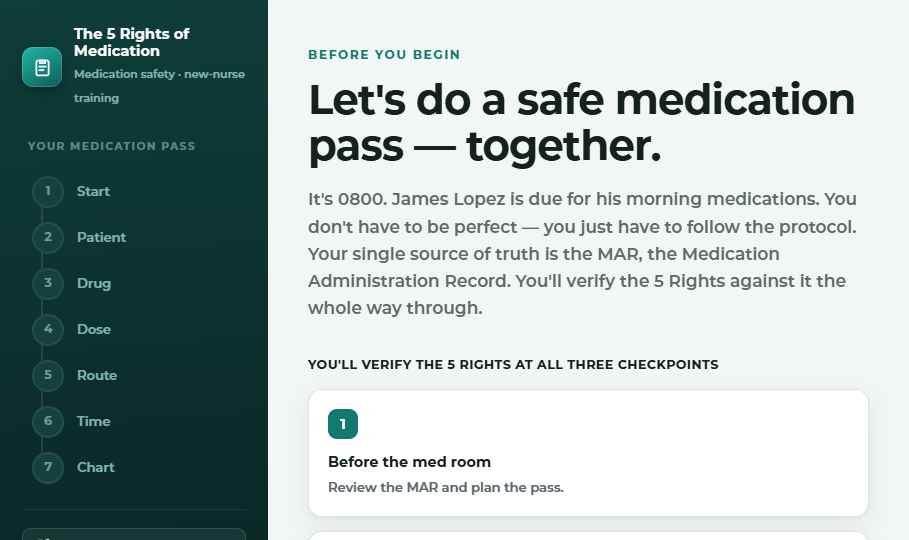
The first builds were clinically correct but pedagogically flat: a single patient and a linear checklist. Each pass moved further from "read the steps" toward "live the shift."
Where It Landed
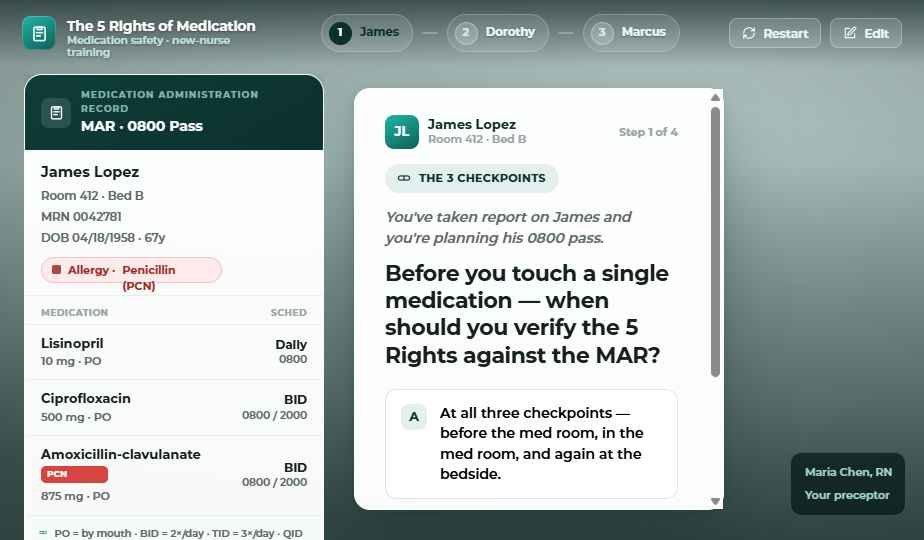
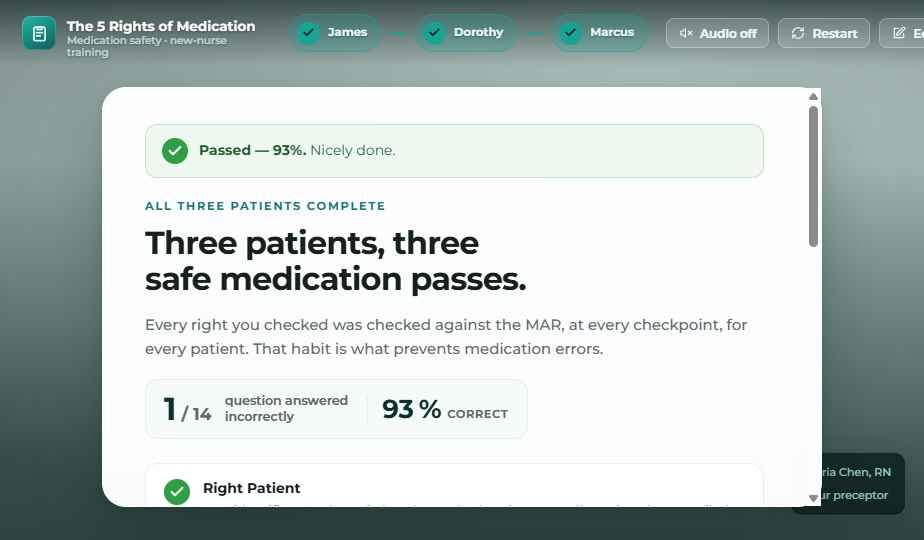
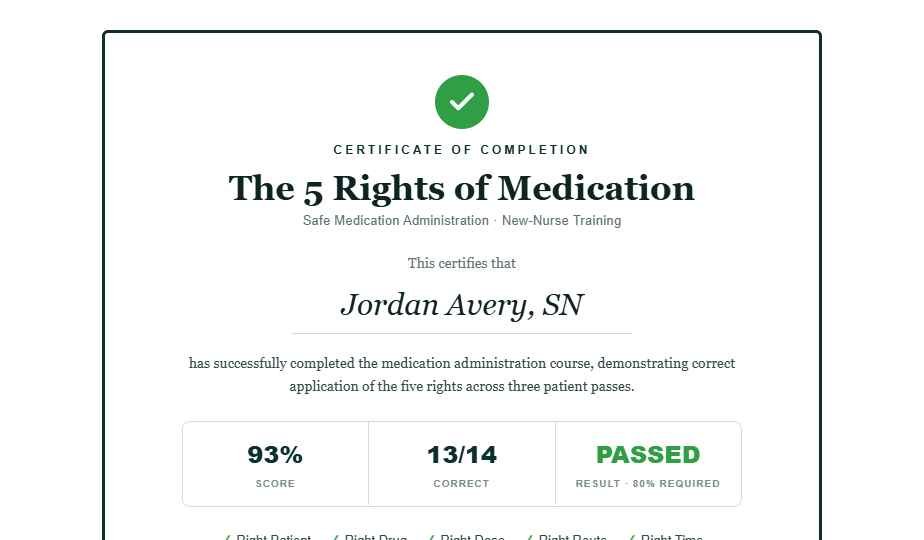
The finished module runs a full medication pass for three patients, each teaching a different pair of rights. Every screen is answered against the MAR, the same discipline the course is trying to instill.
Key Design Decisions
The record stays pinned beside every question. The interface itself enforces the lesson: you answer by reading the source of truth, never from memory.
A miss doesn't just say "incorrect." It names the clinical consequence the SME identified, then returns the learner to try again. Failure becomes the lesson.
A built-in edit mode lets the SME rewrite any clinical line in place. Content accuracy never depends on a developer round-trip.
The Takeaway
Pairing an expert's clinical rigor with AI-speed prototyping let a two-person team ship a training that behaves like the job, not one that just describes it. The expertise stayed human; the iteration got faster.